Why Do Project Teams Keep Recreating the Same Information?
Reuse verified records across reporting, inspections and payment preparation—with versions and approvals intact.

Source: AI-generated concept illustration; layout and editorial direction by Edward Kim | BuildNextSphere.
Note: A conceptual depiction of repeated document work, not an actual submission or integrated DKI screen.
Digital documents, repeated work
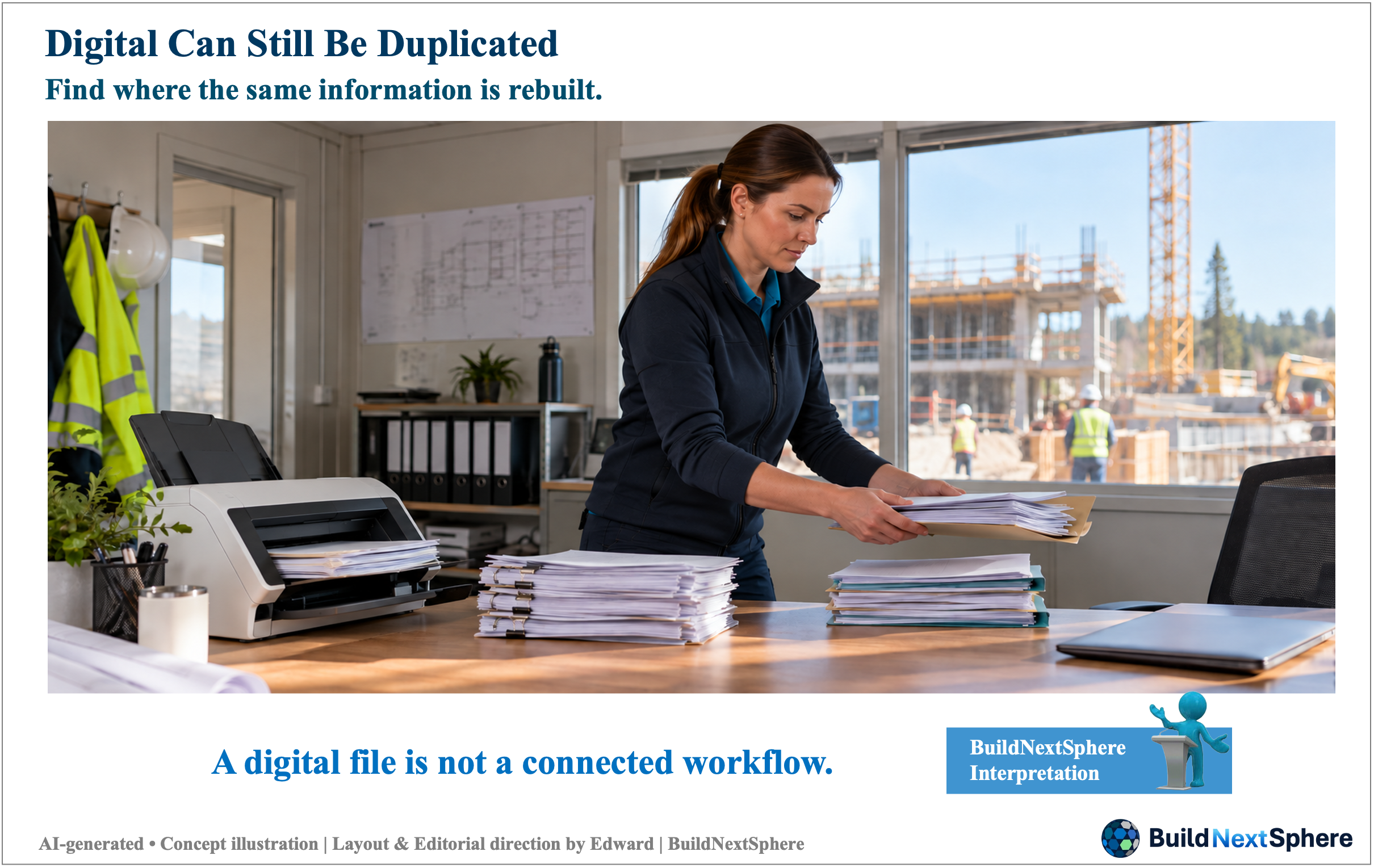
An electronic document system can coexist with substantial retyping and repeated submissions. The file may be digital while the information remains disconnected from the next task. This is the starting point for DKI: how can project teams create, review, approve and retain records so that the same verified information can support more than one legitimate use?
On UAE projects, Edward experienced daily work programmes and actual updates in a work-management system while progress reports and P6 updates were prepared separately. Completed inspection records had to be gathered again for payment submissions. Electronic document management also operated alongside paper submissions. These experiences concern the working arrangement, not a claim that a named software product was defective.
Source: AI-generated concept illustration; layout and editorial direction by Edward Kim | BuildNextSphere.
Note: Inspired by separate reporting and paper submissions on UAE projects; no named software or client is depicted.
Agree the connection before automating it
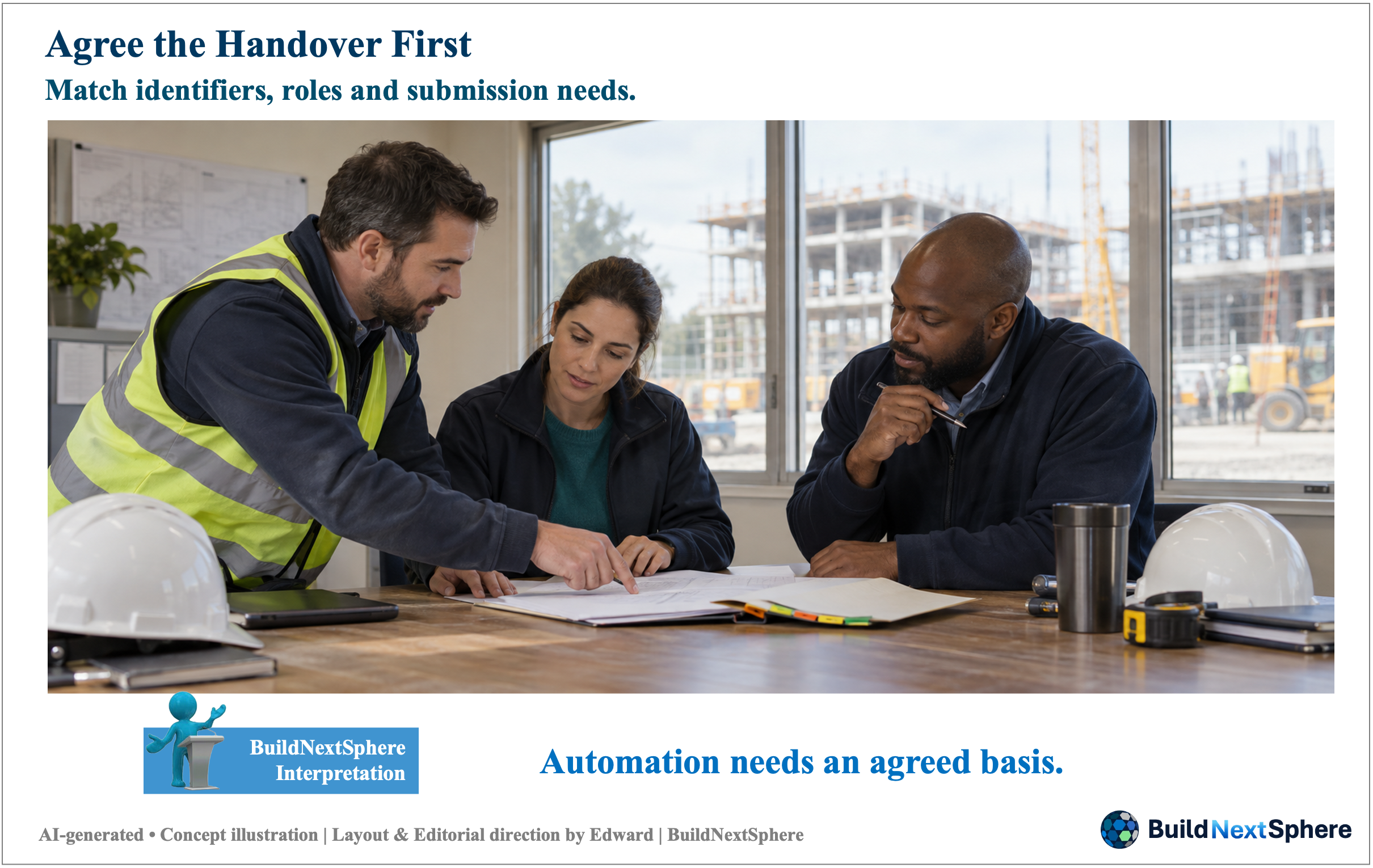
Information reuse needs an agreed connection before it needs an impressive search tool. A work item, inspection request, measured quantity and payment line must be identifiable in a consistent way. The team also needs to know who reviews each record, what approval means and which submission format the receiving party accepts.
Early agreement with the client and supervising team matters. A project cannot unilaterally remove a required submission because its internal database contains the information. The opportunity is to generate the required package from controlled records, preserving references and approvals, rather than asking another person to reconstruct the same evidence. Exceptions should be visible rather than hidden behind a claim of paperless working.
Source: AI-generated concept illustration; layout and editorial direction by Edward Kim | BuildNextSphere.
Note: Conceptual procedure agreement; not a signed client agreement or fixed approval route.
From field progress and inspection to payment preparation
Consider an inspection and payment chain. A request for inspection is not the inspection result. A satisfactory inspection does not, on its own, establish the quantity or amount certified for payment. The relevant evidence, measured quantities, review status and applicable payment basis must remain connected as the record moves between purposes.
The proposed DKI workflow would reuse inspection records and approved quantities to prepare linked payment material. WEI could include inspection activities in task coordination, while PCI uses the appropriate approved progress information. In this series, Certified Payment Amount means the amount certified by the client or supervising engineer. It is not a substitute for earned value in an earned-value management calculation.

Source: AI-generated concept illustration; layout and editorial direction by Edward Kim | BuildNextSphere.
Note: Inspection records can support preparation of payment documents, but inspection and payment certification remain distinct. The scene shows no certified amount or earned-value calculation.
Use the valid record, not simply the newest file
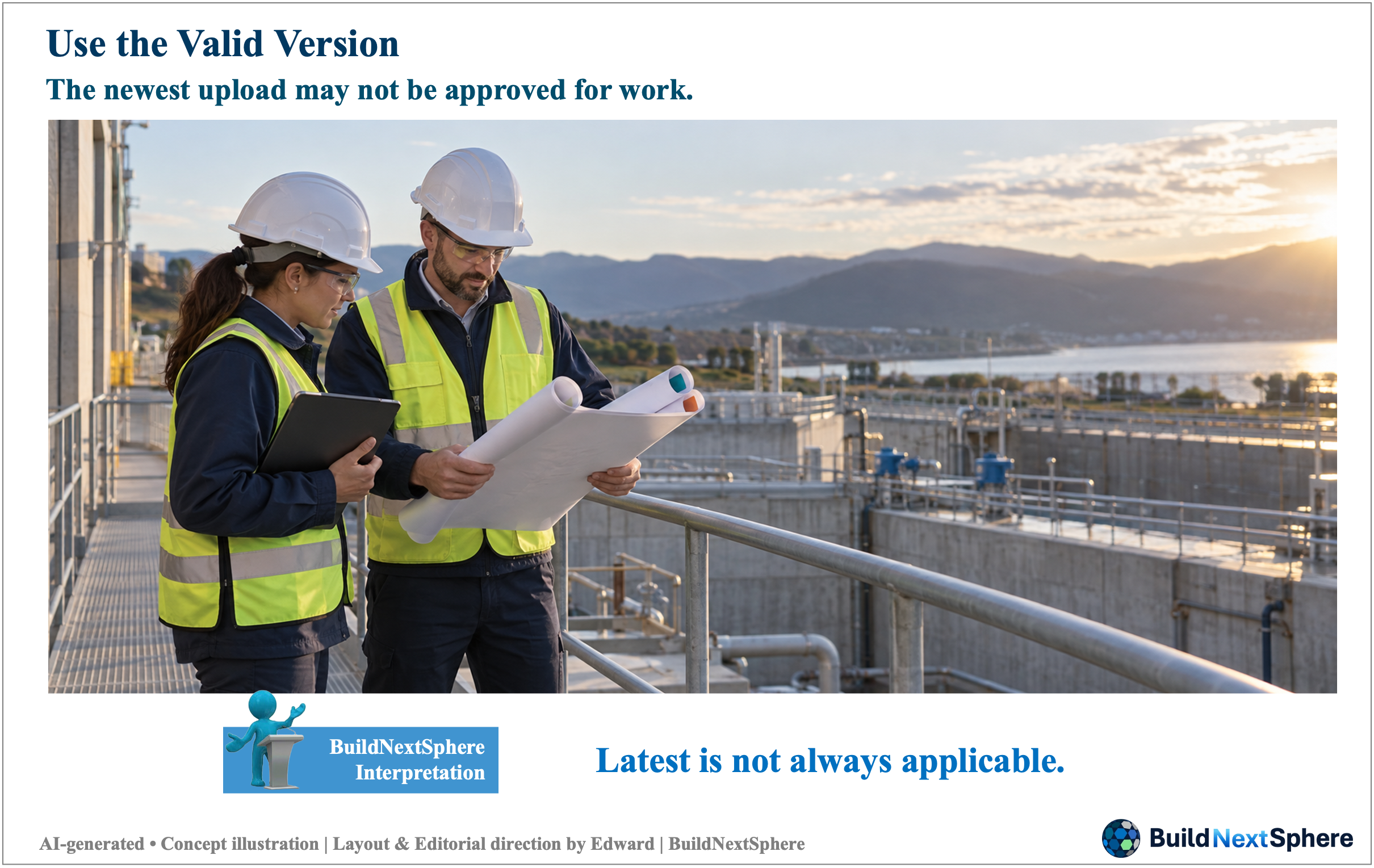
The newest uploaded drawing is not necessarily the drawing authorised for the work. DKI should distinguish revision, approval, applicability and superseded status. A field engineer’s markup can identify a discrepancy and start a review, but it should not silently replace the approved drawing or become a formal contractual notice. The issue needs an owner and a traceable outcome.
The same principle extends to contracts and quality or safety records. DKI manages document versions, review routes and evidence; CCI leads the relevant contractual interpretation. Lessons learned may be captured for later reuse, but a record of one event is not automatically a validated rule for every similar activity. Someone must check the context before turning it into advice.
Source: AI-generated concept illustration; layout and editorial direction by Edward Kim | BuildNextSphere.
Note: Conceptual version check; does not show actual approved drawings or authorise work.
Map one information-reuse chain
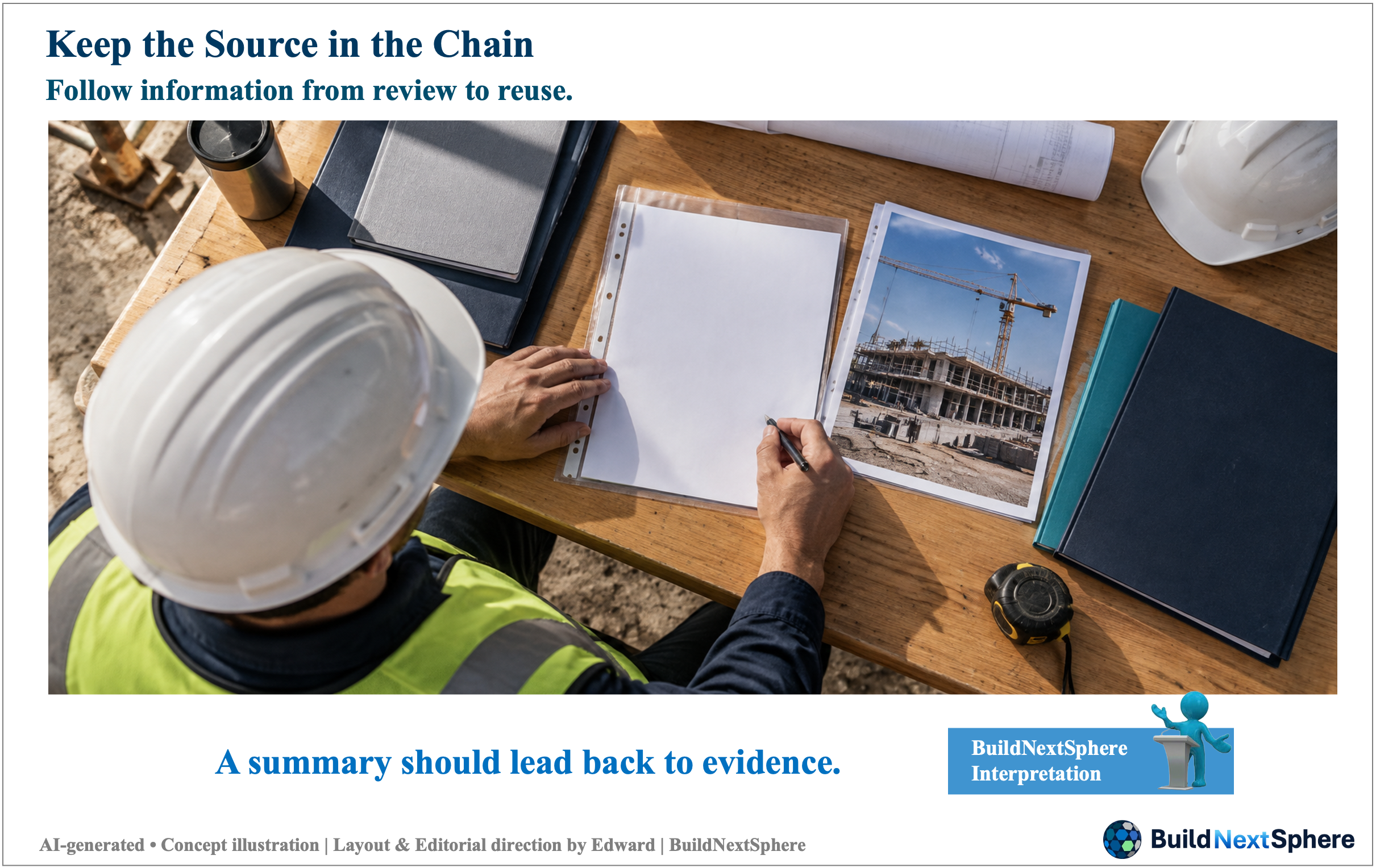
Map one reuse chain through six fields: original record; work and quantity identifiers; version and applicability; review and approval status; intended reuse or submission; and update and outcome history. Keep the link to the original when a summary or derived document is prepared. If the source changes, the team needs to identify which downstream uses may require review.
Reuse must also respect permissions. Transparent working does not mean unrestricted access to personal, commercial or contractual information. The person making a decision should receive the evidence needed for that role, with limitations made clear. A prior approval can be reused as evidence of that approval; it does not automatically approve a new purpose or a changed scope.
Source: AI-generated concept illustration; layout and editorial direction by Edward Kim | BuildNextSphere.
Note: A visual metaphor for traceable reuse, not a database schema or complete document lifecycle implementation.
Make AI a supported route back to evidence
AI retrieval and summaries belong inside this controlled workflow. A useful answer should lead back to the source, valid version and applicable context. If records conflict or the basis is insufficient, the system should identify the gap and request review. A fluent answer with no traceable basis is not a reliable project instruction.
DKI is therefore a proposed common document, approval and information-reuse foundation—not only an AI search feature. Its scope should be implemented in stages, beginning with selected document types and agreed procedures. Choose one inspection or payment process and count where the same information is entered again. The aim is not to abolish necessary documents, but to remove avoidable reconstruction while keeping responsibility intact.

Source: AI-generated concept illustration; layout and editorial direction by Edward Kim | BuildNextSphere.
Note: Future evidence-linked assistance concept; no AI answer accuracy or unrestricted access is implied.
Sources
No external sources cited. The experience account is based on Edward Kim’s direct project experience and subsequent clarifications.
Basis of This Article
The three UAE examples are confirmed personal operating experience. Full document integration, electronic approval and AI retrieval across the proposed PIS scope are future directions, not features claimed for the historical system. Certified Payment Amount is used for client/engineer-certified payment, distinct from EVM earned value.
Related Reading
Explore more from BuildNextSphere:
• Smart Construction, More Tools—Why Is the Site Still So Busy?
• Why Do Projects Fail to Execute the Plan?
• Why Doesn’t Better Technology Always Deliver Better Construction Results?
BuildNextSphere
BuildNextSphere connects Development, Technology & Project Intelligence through practical, experience-informed content.
Explore BuildNextSphere’s development direction and discover more insights through the channels below.
- BuildNextSphere Website
- English Blog | BuildNextSphere Insights
- LinkedIn | Edward Kim
- YouTube Channel
About the Author
Edward Kim is the Founder of BuildNextSphere. He draws on his experience with overseas construction projects to share practical insights from field operations, project delivery, and IT-enabled working systems. Through BuildNextSphere, he explores how people, technology, and real project conditions can help turn plans into action and support better project outcomes.
Content & IP Notice
This article and related materials are prepared by BuildNextSphere. Unless otherwise stated, the original structure, wording, diagrams and visual materials are the intellectual property of BuildNextSphere and Edward Kim. BuildNextSphere, its logo, tagline and brand assets are part of the BuildNextSphere brand identity. Unauthorised reproduction, modification, redistribution or commercial use is not permitted without prior written consent. Third-party names, technologies and references remain the property of their respective owners. General management principles are not claimed as proprietary inventions.


Comments
Post a Comment