The Instruction Was Sent. Can the Work Begin?
Connect work plans, field updates and responsible decisions—without rebuilding the same information.

Source: AI-generated concept illustration; layout and editorial direction by Edward Kim | BuildNextSphere.
Note: The barrier symbolises an unresolved condition; this is not a real incident or proof that a specific work permit was refused.
Sent is not ready
The instruction has been sent. The intended person has acknowledged it. But can the work begin? Those are three different questions. A message can arrive while a required resource is unavailable, a preceding activity remains unresolved, or a changed condition has not reached the person making the next decision. Knowing that an instruction was received is useful; knowing what can actually happen next is more useful.
In Why Build BNS PIS?, I described a principle: connect field facts, schedules and people without adding work merely to serve a system. Here, I want to make that principle more concrete. Task coordination should connect a work plan to assignment, field feedback, a responsible response and a checked result. It should not stop at sending the plan or collecting a completion message.

Source: AI-generated concept illustration; layout and editorial direction by Edward Kim | BuildNextSphere.
Note: Illustrative readiness review; no particular site procedure or universal approval sequence is asserted.
From repeated calls to connected work
My earlier experience on an underground storage project in India made the coordination problem tangible. Reported completion and actual readiness could differ. Resources assigned to one workfront were not necessarily available when another needed them. Records, direct checks and operational adjustments mattered because the next activity depended on the actual condition, not simply on the arrangement shown in a plan.
A later UAE underground storage project provided the setting for a work-management and mobile communication system that we developed and operated. It connected work programmes, resources, field updates and communication. These were actual operating functions in that project. They were not AI capabilities, and they were not a commercially released BNS platform.
The important lesson was the connection between activities and people. If a field update remained inside a message thread, someone still had to find it, interpret it, revise the plan and contact everyone affected. Bringing those steps into a connected workflow could support coordination. It did not remove the need for competent supervision, reliable inputs or someone with authority to decide what should change.

Source: AI-generated concept illustration; layout and editorial direction by Edward Kim | BuildNextSphere.
Note: Conceptual reconstruction inspired by historical coordination experience, not a photograph of the UAE system.
Give each role a usable part of the plan
In the UAE operation, engineers, operators and consultants did not all use the same view of the information. Workfront schedules and changes were made available through role-specific information. Tasks were assigned to engineers and equipment whose deployment at the site had been confirmed, and assignment information could be checked on mobile devices.
This connected planning to the people and resources expected to carry out the work. However, confirmed deployment and receipt were only part of the picture. They did not prove that every preceding condition, inspection or required authorisation was satisfied. A useful coordination record must keep those distinctions visible rather than turn several different facts into a single reassuring status.
For the future BNS approach, I want to retain that role-based principle while making the workflow easier to configure. A participant should see what changed in the work they are responsible for, what needs checking and where a decision is required. That is a design intention for redevelopment—not a claim that a reusable product is already available for every project.
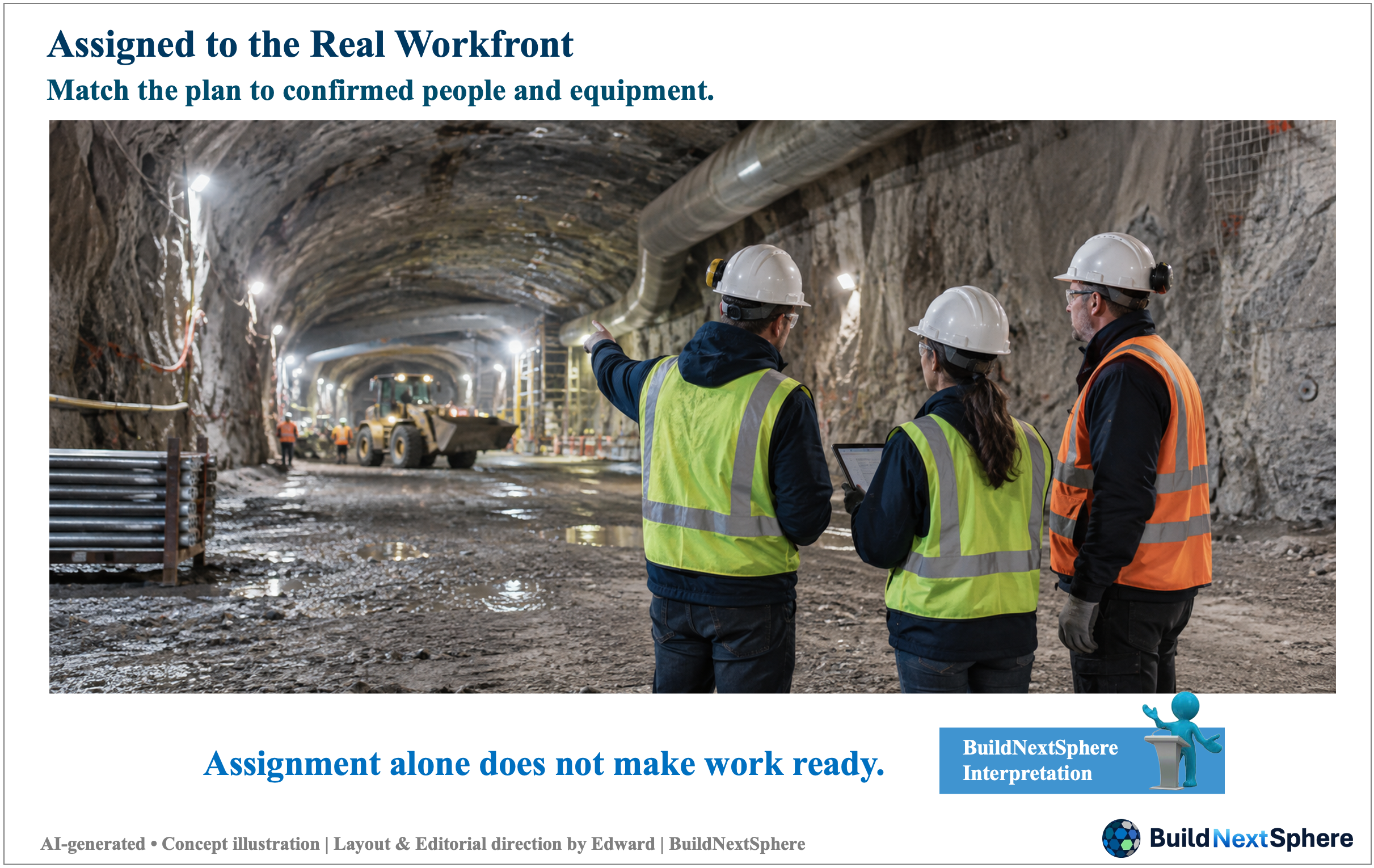
Source: AI-generated concept illustration; layout and editorial direction by Edward Kim | BuildNextSphere.
Note: Roles and deployment are illustrative; the scene does not certify that all work-start conditions are met.
Update before the next task is affected
In the historical operation, engineers updated actual progress after completing work. Before the expected finish, prompts—30 minutes or one hour ahead in the arrangement I described—requested an updated expectation: would the work finish early, on time or late? The point was to obtain a useful forecast before the next coordination decision, rather than discover every change after the planned finish had passed.
When work stopped or a problem arose, the field team could update the situation through mobile communication, and the control room reviewed the information to readjust the schedule. Logic-based schedule calculation and communication supported this process. The timing of a reminder was an operating choice in that setting, not a universal rule for all construction work.
Recalculating dates under established relationships is different from changing the relationships themselves. A forecast can be recalculated when an input changes; a different work sequence or major resource arrangement needs an authorised decision. For BNS, the intended loop is to connect the update, the relevant check, the decision, the revised instruction and the actual result. A forecast or an acknowledgement should not silently become permission to start.
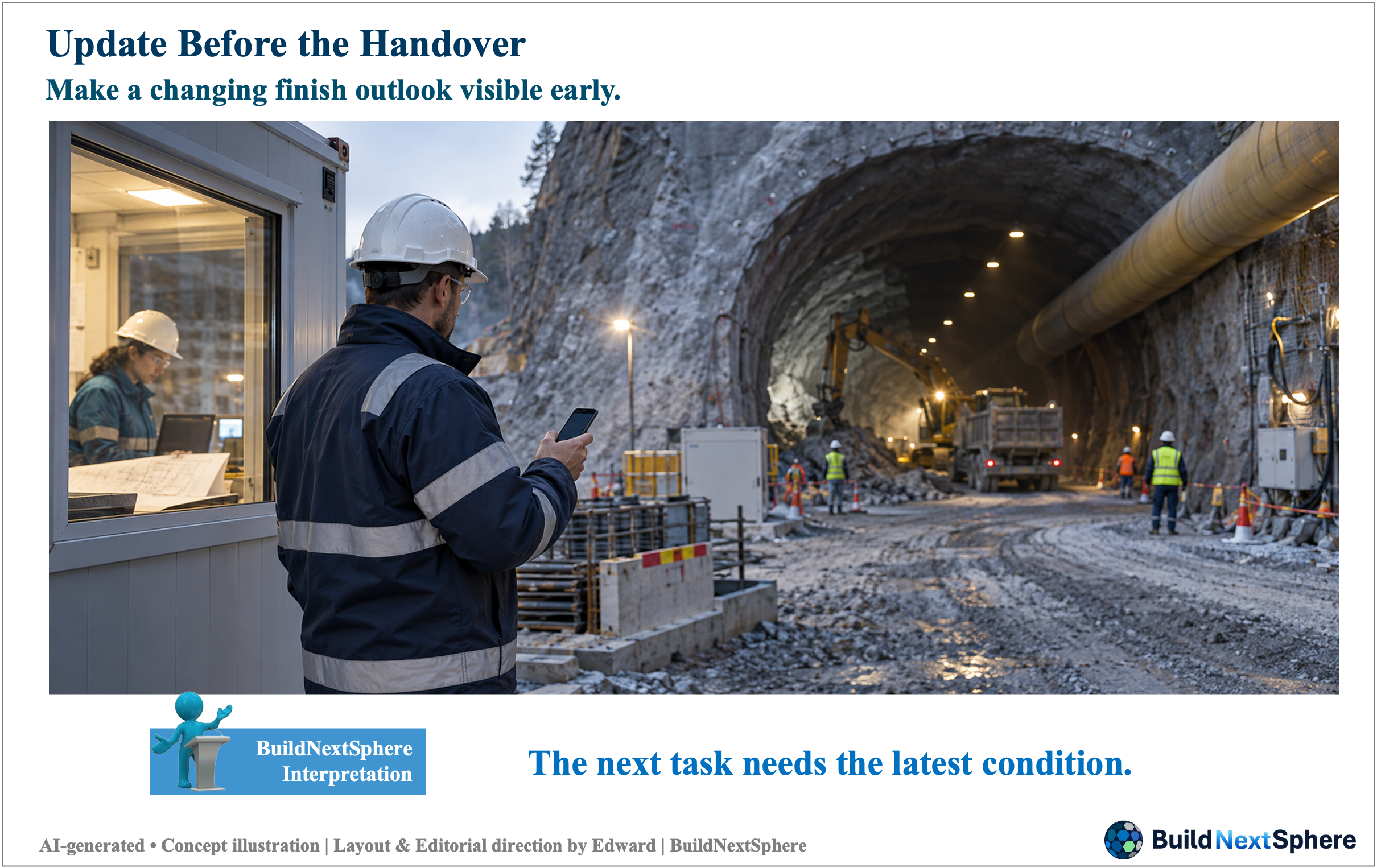
Source: AI-generated concept illustration; layout and editorial direction by Edward Kim | BuildNextSphere.
Note: Illustrates finish-forecast communication; no universal notification interval or live BNS system is depicted.
One task, one connected coordination record
A practical starting point is one recently changed task. Before adding a new form, look at the records already used to plan and perform it. Can the team connect the following six parts without repeatedly rewriting the same information? This is a proposed review aid, not a reproduced historical form or a released product interface.
• The work: task, location, intended timing and completion criteria.
2. The assignment: responsible participant, required resources and acknowledgement of the current instruction.
3. The current condition: progress, remaining work, unresolved constraints, source and update time.
4. The decision: what needs to be resolved, by whom, with what authority and by when.
5. The adjustment: what was authorised, which activities or people are affected and what must be communicated again.
6. The result: what actually happened, who checked the relevant condition and what remains open.
The record is useful only if it helps the next person act. If the same status already exists, connect to it and retain its source instead of asking another person to type it again. If information is old, conflicting or unconfirmed, show that condition. A new screen that hides uncertainty or transfers excessive reporting work to a supervisor would miss the purpose.

Source: AI-generated concept illustration; layout and editorial direction by Edward Kim | BuildNextSphere.
Note: A visual metaphor for the proposed coordination record, not a historical form or finished product screen.
Carry the experience forward, keep decisions human
WEI is a provisional functional label for this direction. BNS Task Coordination Sphere is the product name under consideration. The aim is to redevelop the useful connection between work scheduling, field feedback and communication, with settings that fit different roles and project conditions. It is not simply the former system renamed for sale.
AI could later help identify repeated conflicts, compare possible schedule or resource adjustments and organise information for review. Those possibilities need testing. People would still define the conditions, assess feasibility and approve the relevant changes. Ordinary calculation does not become AI merely because it is automatic; an AI proposal does not become an approved instruction merely because it is persuasive.
A bounded trial should examine the whole burden: entering and checking updates, missed or unnecessary notifications, decision waiting and the ability to continue when connectivity is interrupted. These are proposed review areas, not measured results. Detailed links to the master schedule belong with PCI; analysis of equipment use and productivity belongs with RPI. Task coordination provides the operating connection they can draw on.
Choose one changed task on your project. Who knows the latest condition? What is still preventing the next action? Who can decide, and how will the result return to the plan? The value of a system begins when those questions become easier to answer—not when another message has been sent. Explore BuildNextSphere and share where that connection breaks in your own work.

Source: AI-generated concept illustration; layout and editorial direction by Edward Kim | BuildNextSphere.
Note: Future decision-support concept; no AI capability, approval or successful outcome is demonstrated.
Sources
No external sources cited. The operating account is based on Edward Kim’s first-hand project experience and follow-up clarifications, including those provided on 5 October 2026.
Basis of This Article
The India management experience, the later UAE work-management implementation and the proposed BNS redevelopment are distinct. Role-specific information, confirmed-deployment assignment, mobile updates and finish-forecast prompts are described from the author’s account. The six-part review aid and future AI support are proposals. This article does not provide independent performance verification, improvement percentages or evidence of a released BNS product.
Related Reading
Explore more from BuildNextSphere:
• Why Do Projects Fail to Execute the Plan?
• Between the Plan and the Site: How Can AI Support Project Execution?
• Smart Construction, More Tools—Why Is the Site Still So Busy?
BuildNextSphere
BuildNextSphere connects Development, Technology & Project Intelligence through practical, experience-informed content.
Explore BuildNextSphere’s development direction and discover more insights through the channels below.
- BuildNextSphere Website
- English Blog | BuildNextSphere Insights
- LinkedIn | Edward Kim
- YouTube Channel
About the Author
Edward Kim is the Founder of BuildNextSphere. He draws on his experience with overseas construction projects to share practical insights from field operations, project delivery, and IT-enabled working systems. Through BuildNextSphere, he explores how people, technology, and real project conditions can help turn plans into action and support better project outcomes.
Content & IP Notice
This article and related materials are prepared by BuildNextSphere. Unless otherwise stated, the original structure, wording, diagrams and visual materials are the intellectual property of BuildNextSphere and Edward Kim. BuildNextSphere, its logo, tagline and brand assets are part of the BuildNextSphere brand identity. Unauthorised reproduction, modification, redistribution or commercial use is not permitted without prior written consent. Third-party names, technologies and references remain the property of their respective owners. General management principles are not claimed as proprietary inventions.


Comments
Post a Comment